YA – Quick Guide to Financial Skills (Series NF)

Quick Guide to Financial Skills (series of 6). BrightPoint Press, 2025. 64 p. $34.05 Grades 7-12. 

Crooks-Johnson, Jenny. Quick Guide to Living on a Budget. 978-1-678-20-908-7.
Rowley, Kris Erickson. Quick Guide to Saving and Investing. 978-1-678-20914-8.
—. Quick Guide to Insurance. 978-1-678-20904-9.
Ventura, Marne. Quick Guide to Jobs & Taxes. 978-1-678-20906-3.
—. Quick Guide to Renting. 978-1-678-20912-4.
—. Quick Guide to Loans & Credit. 978-1-678-20910-0.

In Quick Guide to Saving and Investing, readers meet Jesse, who has lost his wallet that held his ID as well as $200 borrowed for a car repair. He calls his sister to ask what to do. Upon learning that he has no savings, she begins to explain why and how to save money and how goals are the motivator. Chapter One defines saving and investing and presents compounding interest. Chapter Two introduces ways to save, including savings accounts, money market accounts, and certificates of deposit. Chapter Three shares ways to invest, including bonds, US Treasury bills, and mutual funds. Chapter Four closes the book with ways to invest in the stock market. Glossary, source notes, further research, and index are included in each book.

THOUGHTS: These books are well-organized, brief overviews of various financial strategies. Targeting struggling readers in grades 7-12, the information is presented in short sentences with much white space between lines and for margins. This makes these books great introductions but limited on details, so further resources could be more robust. Non-threatening presentations on important adulting choices, these should be supplemented with more detailed information or mentorship. This reviewer saw Quick Guide to Saving & Investing and Quick Guide to Renting. 

332 Personal Finance

Elem. – Tamales for Christmas

Briseño, Stephen. Tamales for Christmas. Illustrated by Sonia Sanchez. Random House Studio, 2024. 978-0-593-64781-3. Unpaged. $18.99. Grades K-3.

“With a corn husk in one hand and masa in the other. . .” award-winning author Stephen Briseño repeats this hook to draw in the reader. Tamales for Christmas pays tribute to the loving labor of his abuela in the months before Christmas, as she makes 6,000 dozen tamales in order to have cash for her Mexican-American family’s Christmas gifts. From fall to Christmas, the readers get a count on the bottom of the page as the tamales increase until the big day arrives. The emphasis is not on the gifts or the profit, but on the family’s joy in sharing the holiday together. Sonia Sanchez’s detailed and expressive, double-spread illustrations reverberate with warmth and connection: delicate papel picado banners, colorful tiled backsplash, the ingredients scattered around the page. Coupled with the cumulative text, readers will want to bask in the comfort of abuela’s kitchen. A special bonus is the recipe on the end pages.

THOUGHTS: Though a holiday book, the story speaks to family, work, goals, and love. The slightly messy look of the illustrations are homey and welcoming for read alouds or lap reading. Schools with a high Latinx population should consider this book for their collections; but it is a pleasant addition to any diverse collection. Try a comparison with an older holiday book, Too Many Tamales by Gary Soto. Or teach students about Mexican culture as well as procedural (how-to) text by sharing and following the tamale recipe. Yum!

Realistic Fiction  

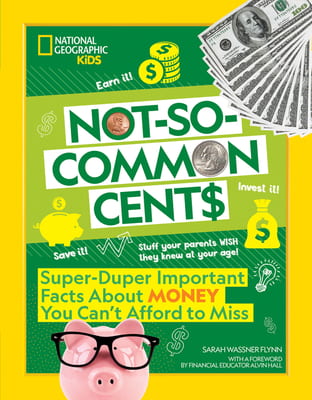
MG – Not So Common Cent$: Super-Duper Important Facts About Money You Can’t Afford to Miss

Flynn, Sarah Wassner. Not So Common Cent$: Super-Duper Important Facts About Money You Can’t Afford to Miss. National Geographic Kids, 2023. 978-1-426-37328-2. 160 p. $14.99. Grades 3-6. 

In full-color, excited ‘did you know this?’ National Geographic style, Not So Common Cent$ introduces readers to money: its history; its creation and evolution; its growth worldwide; and how to make wise money decisions by working, saving, investing, and philanthropy. Financial independence is the goal, because with it, “not only will you have more choices in life, but you’ll also be in a better position to support yourself and others and contribute to your community” (9). The book answers questions like: What makes a coin valuable? When we run out of money, why can’t we just print more? How do countries make money? How does bitcoin work? And of course, money myths and ‘weird but true’ facts. Although this browseable nonfiction book offers just short bursts of information, that information is enlightening and can lead readers to further questions and learning. 

THOUGHTS: A great book for curious kids and a fun way to ease kids into financial literacy.  

332.4 Money