Elem. – This is How a Ball Rolls: The Science of Wobbling, Bouncing, Spinning Balls

Tekavec, Heather. This is How a Ball Rolls: The Science of Wobbling, Bouncing, Spinning Balls. Illustrated by Suharu Ogawa. Kids Can Press, 2025. 978-1-525-30968-7. 32 p. $19.99. Grades K-3.

Heather Tekavec highlights how twelve types of sports balls from a tiny marble to the large person-sized Zorb move. Along with Suharu Ogawa’s detailed illustrations, the descriptions are whimsical and give life to the science behind the balls’ movements. The best part is the interactive page turns where readers can guess which ball will be next. Back matter includes more information about physics as well as some trivia. 

THOUGHTS: This was such a fun book to read-a-loud for a corresponding STEM lesson. Students had a blast guessing what ball was next before turning the pages, and those who enjoy sports were given a chance to learn some science in a fun way. 

531 Classical Mechanics

YA – You Had Me at Hello World

Wang, Rona. You Had Me at Hello World. Simon & Schuster BFYR, 2025. 978-1-534-48851-9. $19.99. 307 p. Grades 7-12.

Charise Tang, a Chinese American teen from a small coastal town in Oregon, is unexpectedly accepted into an elite summer coding program at MIT, which includes travel and full funding. Leaving behind a difficult home life and a community marked by racism and limited opportunities, she travels to Cambridge hoping to carve out a new future. Once she arrives, Char is struck by the privilege and confidence of the other students, but she quickly connects with Khoi Astor, a Vietnamese American participant she meets on her first day. As the program unfolds, Char and Khoi become partners in a high‑stakes hackathon that could give Char the financial security she needs. Alongside the academic pressure, Char must navigate shifting relationships, painful memories, and the emotional impact of trying to build a better life for herself and her mother.

THOUGHTS: This book does a great job mixing a high‑pressure STEM setting with a really personal story about finding confidence and connection. Char’s tough home life and the intensity of the MIT program make her journey easy to root for, and her growing friendship—and eventual romance—with Khoi adds warmth to the heavier moments. The diverse cast and focus on the challenges faced by students from underrepresented backgrounds help ground the story in real‑world issues. Overall, it’s an engaging, heartfelt read that blends tech, teamwork, and self‑discovery in a way that feels both relatable and uplifting.

Romance

MG/YA – Fascinating Food

Fascinating Food. Essential Library, an imprint of Abdo, 2025. $30.00 ea. $240.00 set of 8. 112 p. Grades 6-12. 

Sonneborn, Liz. The Fast Food Industry. 978 -1-098-29524-0.
Burling, Alexis. Food and Culture. 978-1-098-29525-7.
—. Food Delivery. 978-1-098-29526-4.
Edwards, Sue Bradford. Food in Space. 978-1-098-29527-1.
Waldendorf, Kurt. Food Marketing. 978-1-098-29528-8.
Hogan, Christa C. Food Science. 978-1-098-29529-5.
Sonneborn, Liz. How Supermarkets Work. 978-1-098-29530-1.
Wheeler, Jill C. Modern Farming. 978-1-098-29531-8.

Food in Space is a title in the Fascinating Food series. During the early days of human spaceflight in the 1960s, scientists faced the difficult problem of figuring out how astronauts could eat safely and nutritiously without gravity. Food in Space traces how space‑food technology has evolved from the first Mercury missions through current expeditions to the International Space Station, showing how researchers improved both the nutrition and practicality of meals designed for orbit.

THOUGHTS: The book succeeds in making the science approachable, showing how space‑food technology has progressed from simple, early Mercury‑era meals to the more complex dining options available on the International Space Station today. Its inclusion of infographics, a glossary, and clear source notes helps break down technical concepts and makes the material accessible for student researchers. The alignment to Common Core and state standards also makes it a strong fit for classroom use. Overall, the book provides a thoughtful, informative introduction to an unusual corner of food science and space history.

600’s Technology and Applied Sciences

Elem. – Baby Ballena

Gundersheimer, Ben (“Mister G”). Baby Ballena. Illustrated by Marcos Almada Rivero. Nancy Paulsen Books, 2025. 978-0-593-62484-5. $18.99. Unpaged. Grades PreK-2.

Born in the warm waters of Mexico, Juana is a one-day-old gray whale. She and her pod head north towards Alaska, where they will be spending their summer. They pass landmarks like the Rocky Mountains and the Golden Gate Bridge, and they are careful to avoid ships, fishing nets, and orcas. After arriving in Alaska, Juana spends her summer eating and growing before she must make the return journey to Mexico to spend the winter. Beautiful illustrations accompany this extremely accessible introduction to the migration patterns of baleen whales.

THOUGHTS: Although the story itself is very straightforward and simple, I believe this book has a lot of potential uses in an educational setting. The book is written in both Spanish and English, so it would be a great selection for a bilingual storytime. It also could be used to introduce a unit on migratory animals. The story does manage to incorporate simple facts about gray whales, such as their sizing, their migratory patterns, and the fact that they eat shrimp. The author’s note at the end highlights some conservation efforts we can make to protect the whales in our oceans. Overall, the book seems like it would be a valuable addition to any elementary bilingual/science collection.

Picture Book

Elem. – Wow, It’s Weather! (Series NF)

Leatherland, Noah. Roar! Books: Wow, It’s Weather! Bearport, 2025. 24 p. $21.02 ea. $84.08 Set of 4. Grades 3-5.

What’s Going on When It’s Cold.  979-8-892-32870-8.
What’s Going on When It’s Hot. 979-8-892-32871-5.

What’s Going on When It’s Stormy. 979-8-892-32872-2.
What’s Going on When It’s Wet. 979-8-892-32873-9.

A useful hi-lo nonfiction set to learn the basics of weather conditions through accessible text. Each book begins with the question, “What is weather?” and sets the tone for interesting facts, clear text features, and engaging color photography. Appealing sections about what can go wrong and how to stay safe in weather conditions will attract readers. These books include a table of contents, glossary, and index.

THOUGHTS: The high interest subject matter and low vocabulary fill an important gap in school libraries that serve a range of learners. Reluctant readers, ELL students, and dyslexic students will be supported with these books. A good addition for curriculum with weather units.

551.5 Meteorology

Elem. – We LEAP Together

Neal, Christopher Silas. We LEAP Together. Alfred A. Knopf, 2025. 978-0-593-81265-5. Unpaged. $19.99. Grades K-2.

A beautiful presentation of two side-by-side stories, one of a whale calf and the other of a young boy, navigating their daytime adventures. Through alternating pages, the book follows the whale calf and the boy as they explore their respective worlds with their mothers always close by. A joyful ending brings the two youngsters to the same location: the New York City Harbor, where the boy and whale encounter each other on a whale watching boat. 

THOUGHTS: Neal’s illustrations are sensitive and lovely, highlighting the similarities between humans and whales. Backmatter offers information to support the fact that “Whales are like us!” In the classroom, this book will be ideal for a lesson on mammals using a Venn diagram.

Picture Book

Elem. – Max, a Little Axolotl

Spiotto, Joey. Max, a Little Axolotl. Graphix, 2025. 978-1-546-16945-1. 121 p. $12.99. Grades 1-3.

Max, a little Axolotl, was born in southern Mexico’s beautiful Lake Xochimilco. Life was peaceful until workers arrived and threatened his fragile habitat with their construction project. Luckily for Max, a kindly conservationist relocated him to the Aquarium of the Bay. There, three months later, Max is ready for his first day at school! In addition to his start-of-school jitters, Max feels especially conspicuous as the only axolotl at school. He settles in with the help of an attentive teacher and some new friends, but when he accidentally kicks a ball into a mysterious cave, a new adventure begins. Max bravely ventures into the lair of the “water monster” to retrieve the ball … and then again to retrieve the backpack that he dropped. It turns out the water monster isn’t so monstrous after all. In fact, he is an axolotl just like Max, and that isn’t all they have in common! This graphic novel features bright colors and expressive characters. The ending hints at another lighthearted escapade for Max and his friends; Max, a Little Axolotl #2 is coming in May, 2026! 

THOUGHTS: This adorable series-opener has what young readers love: cute animals, underwater hijinks, and the message that a “friend can make all the difference.” Author and illustrator Joey Spiotto includes fascinating “Facts-olotl” at the book’s conclusion for further STEM connections.

Graphic Novel

Elem. – The Secret Life of a Sea Turtle

Bearzi, Maddalena. The Secret Life of a Sea Turtle. Illustrated by Alex Boersma. Roaring Brook Press, 2025. 978-1-250-90167-5. 48 p. $19.99. Grades 2-5.

“On a starry night within the fine sand of the shores at Ría Lagartos, a nature reserve on the Yucatán Peninsula, a female sea turtle is about to hatch.” So begins this scientifically detailed, often harrowing, and gorgeously illustrated look into the secret life of a sea turtle. The book opens with “our” sea turtle and her hundred siblings hatching, emerging from their nest, and scurrying down the slope of the beach to tumble into the surf. Along the way many fall victim to predators including crabs, raccoons, and pelicans; of one hundred eggs, less than a dozen make it out to sea. Their perilous journey from nest to the open ocean is documented with exciting, full-page spreads that showcase the dangers they face. Very little is known about the sea turtles’ lives over the next few years. Researchers believe that juvenile turtles travel along currents in the Atlantic Ocean, evading dangers from sharks to fishing nets. Eventually, returning to the Ría Lagartos shoreline as a mature green turtle, she will mate, lay eggs, and begin the cycle anew. (One panel depicts mature turtles mating.) Back matter includes information on actions that readers can take to protect sea turtles, different species of sea turtles, and much more. 

THOUGHTS: The turtle’s story is fascinating, and Alex Boersma’s paper and graphite illustrations (digitally colored blue, green, and sandy brown in Adobe Photoshop) truly bring it to life. Readers will have great fun identifying “our” sea turtle on every page of this memorable, STEM-connected title!

597 Turtles

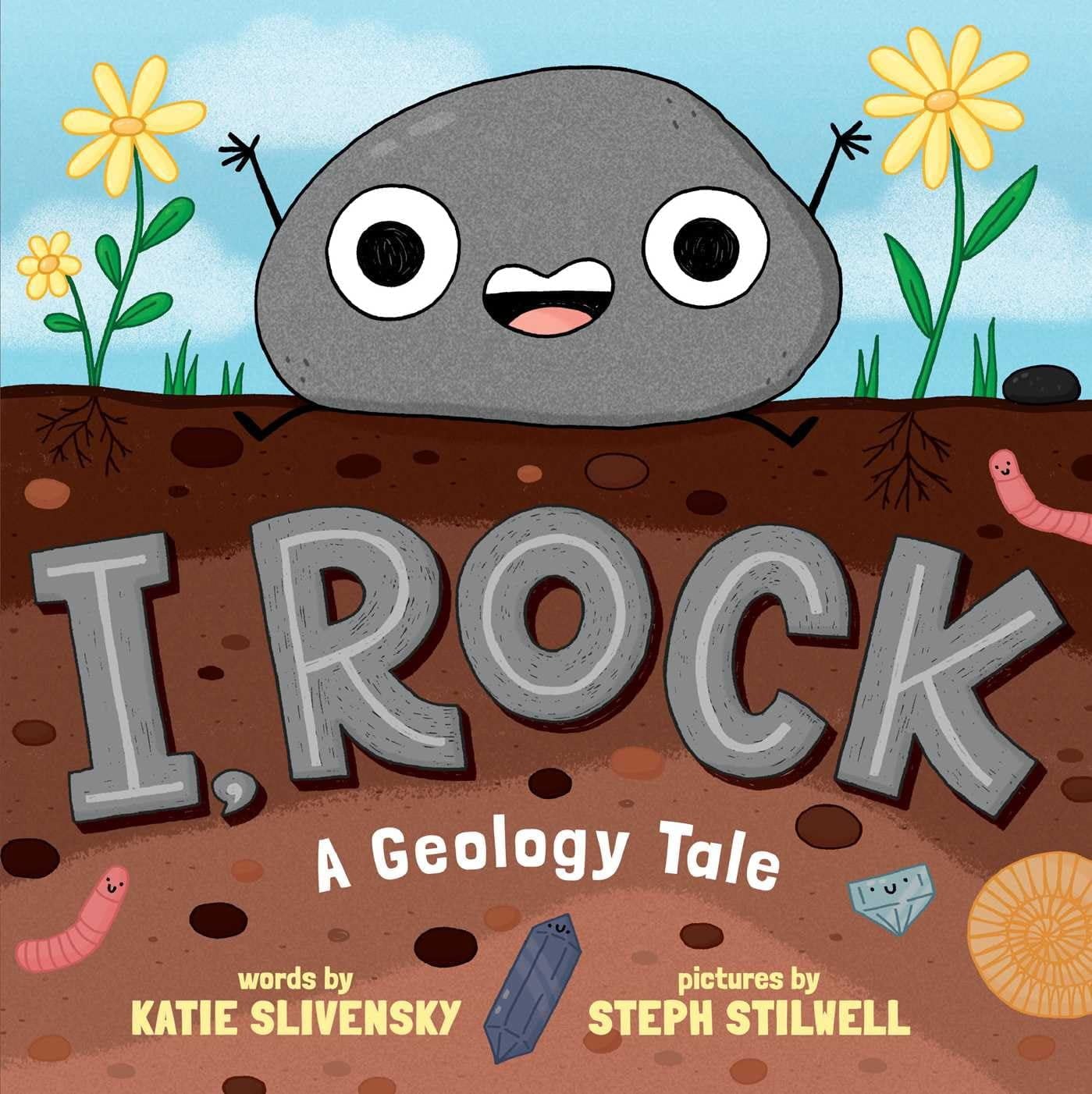
Elem./MG – I, Rock: A Geology Tale

Version 1.0.0

Slivensky, Katie. I, Rock: A Geology Tale. Illustrated by Steph Stilwell. Beach Lane Books, 2025978-1-665-94036-8. Unpaged. $19.99. Grades K-7.

After being carried into a classroom on the bottom of a student’s shoe on senior citizen interview presentation day, an unnamed rock leads students through a fascinating geology evolution story! Who knows someone older than a rock that’s seen it all? Starting 4.3 billion years ago, the rock takes students through its formation from minerals, moving around the Earth’s layers, erupting from a volcano, landing on the ocean floor, and continuing to move on Tectonic plates. With over 1 billion years to go until present time, this rock has much more on their journey! Young readers will learn all about the types of rocks (igneous, sedimentary, and metamorphic) while also learning about Earth science terms like specific minerals and layers of Earth, tsunami, supercontinent, erosion, and more. While packed with a ton of scientific information that could be overwhelming for young learners, this title may inspire future scientists. Coming back to the title again and again only will lead to new discoveries. Older students will find a wealth of information in the text and back matter (awesome geology facts, geology pop quiz, and sources) for Earth science-related reading or research. Hand drawn, digitally colored illustrations bring the text of this picture book to life and will make it a popular selection for young readers.

THOUGHTS: Use this title as a humorous (the rock is a pretty awesome narrator), informational read aloud ahead of an earth science unit or research project, and encourage students to go back for all of the information in call outs. Highly recommended for elementary collections and secondary collections serving an Earth science course! 

Picture Book
551 Geology 

Elem./MG – The Sustainable School: A Journey Through Time and Energy

Fyvie, Erica. The Sustainable School: A Journey Through Time and Energy. Illustrated by Scot Ritchie. Kids Can Press, 2025. 978-1-525-30668-6. $17.99. 56 p. Grades 3-6. 

Birch Elementary is under construction to make their school more sustainable when construction workers find a time capsule buried in the ground. Students in the school’s sixth grade class find letters written by students in the 1900’s focusing on technological innovations of their time period–indoor plumbing, electric lights, and innovations in transportation. Mr. Moran’s class is inspired by the time capsule they have found and embark on a new assignment: They conduct research to determine how they could make their school more sustainable and energy efficient by the year 2100. The class divides into groups that focus on specific areas such as building design, electricity, plumbing, and transportation. Their research helps them to imagine what their school could look like with evolved energy solutions and technological advancements. 

THOUGHTS: This book is highly engaging and packs a lot of information into 56 colorfully illustrated pages. I loved how seamlessly this title incorporated technological innovations of the past with energy and technology needs of the present and future. The book takes a graphic novel format and style but also includes definitions that are set in different colored boxes within the narrative to provide definitions for the domain-specific terms. There is a glossary page, additional resources, and index at the back of the book. In The Sustainable School, Fyvie blends history, science, and technology together to make sustainability a concept that is fun and accessible, and exciting to learn about. 

304.2 Social Science