Elem. – The Buzz on Wild Bees: The Little-Known Pollinators That Keep Our Planet Humming

Vermond, Kira. The Buzz on Wild Bees: The Little-Known Pollinators That Keep Our Planet Humming. Illustrated by June Steube. Owlkids Books, 2025. 978-1-771-47617-1 35. p. $22.95. Grades 3-5.

While honeybees are among the most familiar pollinators, there are approximately 20,000 known species of wild bees worldwide. In fact, wild bees make up more than 90% of the bee species on earth. Evolution is to thank for why our planet has so many different types of bees. Flowering plants have changed over time to attract pollinators; bees also have changed, so they can gather food more easily from the plants that grow near their habitats. Alkali bees are known to nest near one another, whereas other species are solitary; in contrast, the cuckoo bee leads a parasitic lifestyle. The female cuckoo bees lay their eggs in the nest of a different bee while they are away searching for food. All bees, no matter their species, play a vital role in pollinating plants. Unfortunately, climate change, habitat loss, pesticide use, and disease pose a serious threat to bee habitats and survival. That’s why it’s important for humans to plant patches of native wildflowers, construct bee hotels, and avoid pesticides. It is especially important to save wild bees because their plant pollination is responsible for about one in three mouthfuls of food we eat. Consequently, protecting the diversity of wild bees through habitat conservation and sustainable practices is vital for maintaining the food supply we depend on.

THOUGHTS: This accessible and engaging nonfiction title introduces readers to the remarkable diversity of wild bees by using rich, reader-friendly descriptions to explain key concepts. Vibrant, detailed illustrations portray bees in their natural environments. Bee-themed jokes and puns add humor alongside abundant fact and practical guidance. Back matter includes a glossary and a selected bibliography for further inquiry. This would be a great purchase for an upper-elementary library.

500s Science/Zoology
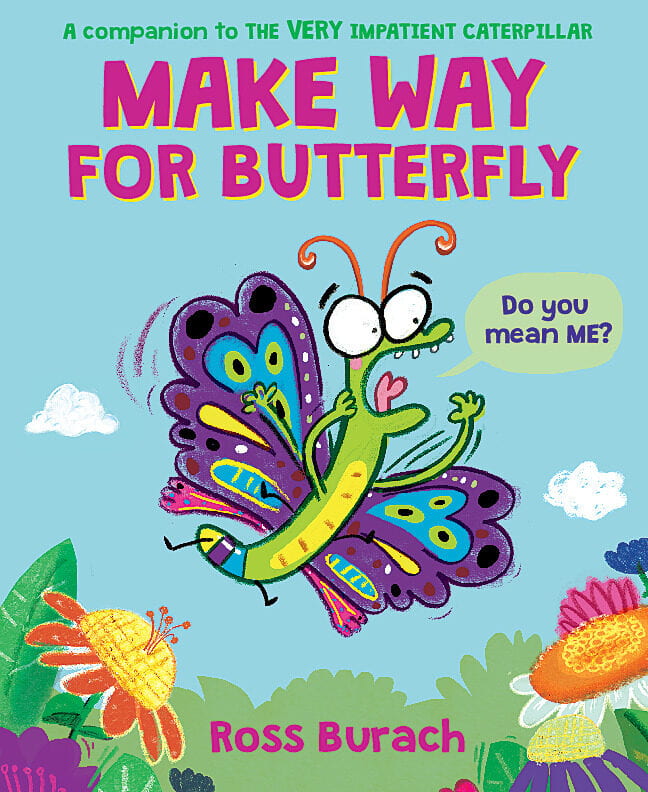
Elem. – Make Way for Butterfly

Burach, Ross. Make Way for Butterfly. Scholastic, 2023. 978-1-338-75263-2. Unpaged. $18.99. Grades PreK-3.

Make Way for Butterfly begins when Bee buzzes past Butterfly, who is relaxing on a flower. Curious, Butterfly asks Bee what they are doing, and launches into an explanation of pollination from Bee. The more Butterfly learns, the more desperate they become to be just like Bee. When Butterfly learns how Bee’s sticky hairs help with pollen collection, they break out the glue. When Butterfly learns about Bee’s pollen baskets, they attempt to create baskets of their own… and then comes the jet pack, and fuzz, and stingers, and stripes. In the end, Butterfly learns that, even without speed, fuzz, stingers, stripes, pollen baskets, and sticky hairs, their unique way of pollinating is very important to the ecosystem as well.    

THOUGHTS: Make Way for Butterfly combines bright illustrations, scientific fact, and humor to tell a tale that will engage young readers and encourage multiple readings… and might just hook the adults that read to them, too. The science in the story is sound, and the message about being yourself evolves throughout the book without being heavy-handed. This a book young readers will love and seek on library shelves. Highly recommended.

Picture Book

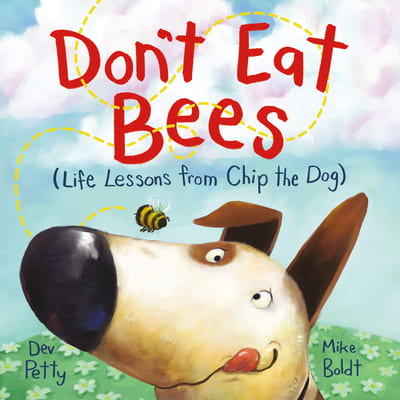
Elem. – Don’t Eat Bees (Life Lessons from Chip the Dog)

Petty, Dev. Don’t Eat Bees (Life Lessons from Chip the Dog). Doubleday Books for Young Readers, 2022. 978-0-593-43313-3. $23.99. Grades K-2.

Chip is a very smart dog. You see, although he is only 7 years old in people years, he is very old in dog years. Chip has learned lots of lessons along the way, most of them being about things that you can eat and things that you cannot eat. For example, you can eat shoes, or plants, or the important papers the small human being brings home. You cannot eat, however, bees. Peas are fine, but bees are not! It is very important to remember that you cannot eat bees… even if you really, really want to… at least, you should try your best to remember not to eat them more than once!

THOUGHTS: An adorable book filled with simple life lessons from a dog! After all, it is important to remember not to eat bees, even when you may really want to!

Picture Book          Rachel Burkhouse, Otto-Eldred SD

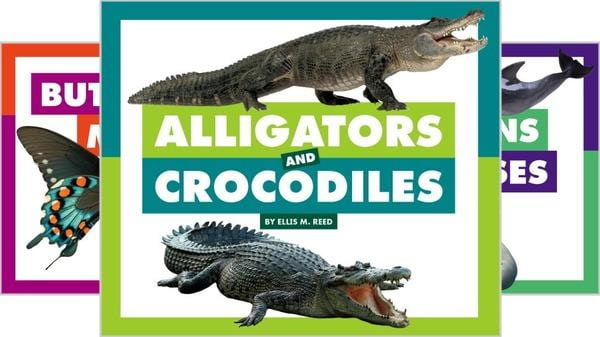
Elem. – Comparing Animal Differences (Series NF)

Comparing Animal Differences. The Child’s World, 2020. $19.95 each. $342 for a set of 12. 24 Pages. Grades K-3.

Reed, Ellis M. Alligators and Crocodiles. 978-1-503-83590-0.
—. Llamas and Alpacas. 978-1-503-83593-1.
York, M. J. Butterflies and Moths. 978-1-503-83587-0.
—. Toads and Frogs. 978-1-503-83586-3.
Pearson, Marie. Dolphins and Porpoises. 978-1-503-83589-4.
—. Leopards and Cheetahs. 978-1-503-83592-4.
—. Wasps and Bees. 978-1-503-83594-8.
Gale, Ryan. Hares and Rabbits. 978-1-503-83591-7.
—. Turtles and Tortoises. 978-1-503-83588-7.
London, Martha. Lizards and Salamanders. 978-1-503-83595-5.
Ringstad, Arnold. Puffins and Penguins. 978-1-503-83596-2.
Gendell, Megan. Spiders and Daddy Long Legs. 978-1-503-83585-6.

Do you know what makes a toad different from a frog? Or a rabbit from a hare, or a lizard from a salamander? If you are like most readers, this is an ever confusing problem, which the writers of the Comparing Animal Differences series would like to simplify. Using short chapters of readable text with gorgeous photographs, each book highlights the animals separately, and then compares how to identify the difference. For example, lizards have scales and claws and hunt during the day, while salamanders are nocturnal and have no claws or scales. With labeled photos, a glossary and index, as well as extra links and activities to extend the learning, young readers will become knowledgeable naturalists in no time.

THOUGHTS: There are twelve books in this series. I have only reviewed two, but feel that the collection as a whole would be worth purchasing for class projects and personal interests. Plus, the idea of a compare and contrast assignment would be a useful note taking lesson.

550 Animals          Dustin Brackbill, State College Area SD

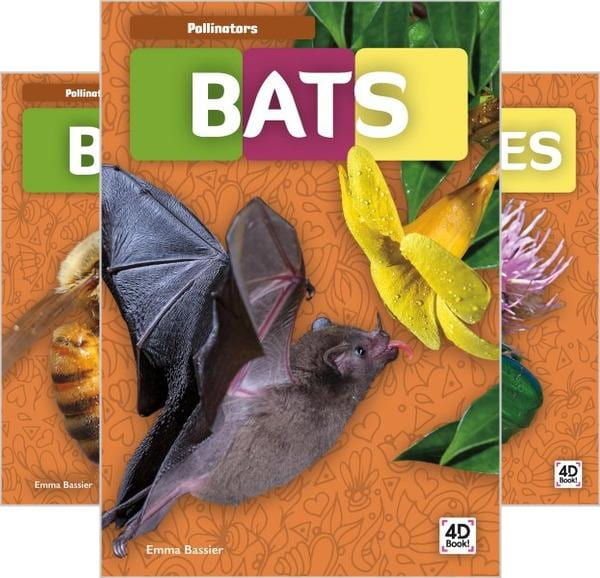
Elem. – Pollinators (Series NF)

Pollinators. DiscoverRoo, 2020. $168 set of 8. 32 p. Grades 3-6.

Bassier, Emma. Bats. 978-1-53216-592-4.
—. Bees. 978-1-53216-593-1.
—. Moths. 978-1-53216-598-6.
—. Wasps. 978-1-53216-599-3.
London, Martha. Beetles. 978-1-53216-594-8.
—. Butterflies. 978-1-53216-595-5.
—. Flies. 978-1-53216-596-2.
—. Hummingbirds. 978-1-53216-597-9.

Who knew pollen could be so interesting? DiscoverRoo’s “Pollinators” series gets elementary nonfiction right. Straightforward text explains the pollination process and provides details on pollinators and their habitats, habits, and issues surrounding the various types of creatures. “Honeybees can visit 5,000 flowers in one day.” Wow! Beautiful photographs, plenty of white space to keep page layout looking clean, QR codes sprinkled throughout the text, and lots of helpful nonfiction text features keep these titles feeling fresh. Each book includes a table of contents, glossary, index, and an online resources section accessible via a QR code for further learning opportunities.

THOUGHTS: Invest in this set if creature features are popular or if looking to update supporting science series.

590s Animals/Insects          Lindsey Long, Lower Dauphin SD

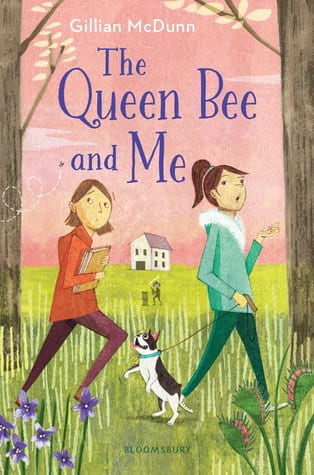
MG – The Queen Bee and Me

McDunn, Gillian. The Queen Bee and Me. Bloomsbury Children’s Books, 2020. 978-1-681-19751-7. 279 p. $16.99. Grades 5-7

Meg has always been joined at the hip of best friend Beatrix, except for the times when Beatrix freezes her out. Afraid of angering Beatrix and losing the benefits of being her friend, Meg decides to follow along while Beatrix plots to bully new student Hazel and her mom out of town. When Meg and Hazel get partnered up for a bee project in a science elective, Meg struggles between following her passion for science and doing whatever it takes to keep Beatrix from getting angry. It turns out Meg and Hazel have a lot in common, and they have fun together. Can Meg stand up to Beatrix even if it means risking years of friendship and the comfort of having a best friend? By the end of the story, Meg faces many of her fears, including a fear of bees, oral reports, and standing up to Beatrix which makes a sweet, but predictable, ending. 

THOUGHTS: As an adult reader, I had trouble finishing the book due to the predictable storyline. I anticipate young readers enjoying and relating to this story once they have the book in their hands and time to read.

Realistic Fiction          Jaynie Korzi, South Middleton SD

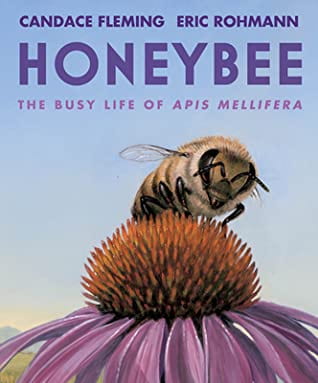
Elem. – Honeybee: The Busy Life of Apis Mellifera

Fleming, Candace, and Eric Rohmann. Honeybee: The Busy Life of Apis Mellifera. Neal Porter Books, 2020. 978-0-8234-4285-0. Unpaged. $18.99. Grades K-2.

On a summer morning, a new life begins, a new honeybee emerges from her cell. With characteristically flawless prose, Fleming guides the reader day by day through the short life cycle of the honeybee. The new worker bee immediately begins tasks about the hive, from cleaning, to feeding larva, to tending the queen. At approximately four weeks, the worker transitions to a forager, seeking nectar and communicating its location to other foragers. This job will consume the honeybee for the rest of her days. Fleming’s text is gently poetic, imbuing grace and beauty to the life of the bee and the hive. Caldecott winner Rohmann’s eye-catching artwork adds another layer to the experience and is not for the faint-of-heart.  Illustrations of the bee are enormous, covering entire pages. Some young readers will thrill to the extreme closeups of eyes and antenni, but other, more bug-phobic, children (and adults) may find the pictures terrifying.

THOUGHTS: This is a lovely, lyrical peek inside the hive and the life of the honeybee, but know your audience before using it as a read-aloud.

Picture Book          Nancy Nadig, Penn Manor SD

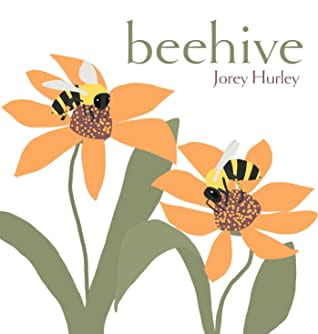
Elem. – Beehive

Hurley, Jorey. Beehive. Simon & Schuster Books for Young Readers, 2020. 978-1-481-47003-2. $17.99. Grades PreK-K.

A simple picture book, Beehive explores the world of a honeybee. Using one word on a page, this beautifully illustrated book shares different events in a bee’s life. We see the bee FLY, EXPLORE, and POLLINATE. We watch as the bee LAYs, FEEDs, and GROWs. A fun picture book filled with important words that can help explain the life of a honeybee!

THOUGHTS: My favorite part of this book actually appears in the author’s notes. The author uses each word from the book and explains the life of the honeybee in further detail. This would be a fantastic piece of information to use for continuing education of the honeybee or for older students who may require more information.

Picture Book          Rachel Burkhouse, Otto-Eldred SD